
October 21, 2026 · 8 min read
AI advertising tools: which layer does your account need?
AI advertising tools split into four layers: platform-native AI, creative generation, autonomous optimization and ad intelligence. Score your account, then buy where the bottleneck is.
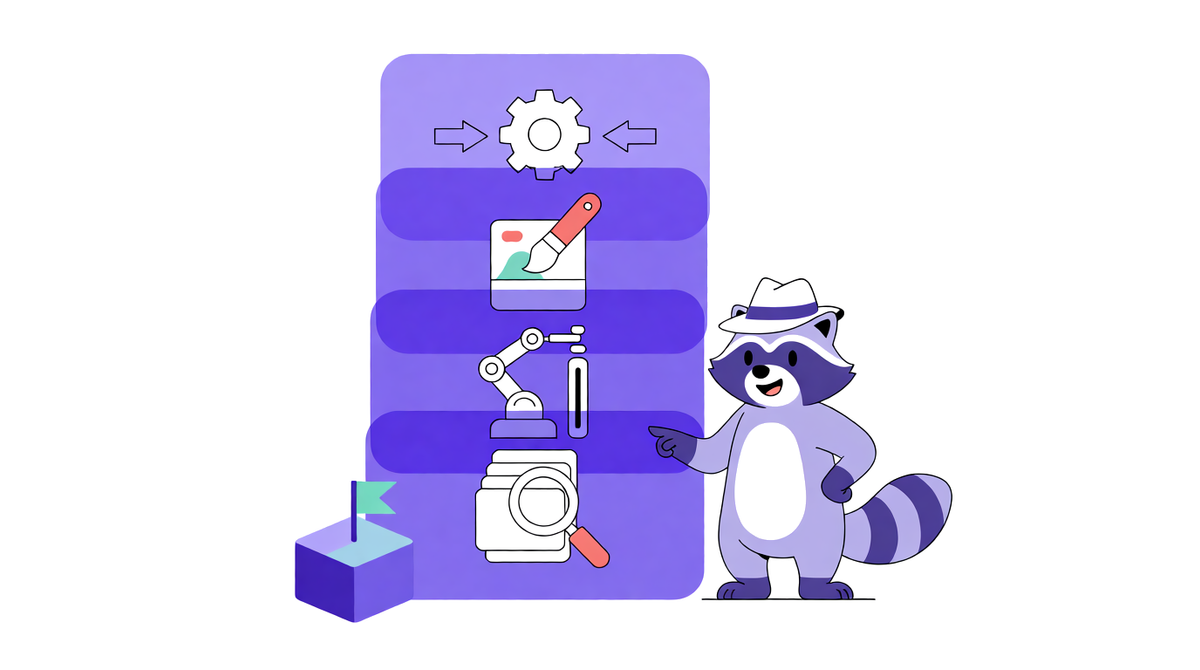
An AI advertising tool is software that uses machine learning to create, target, bid on, or analyze paid ads. In 2026 these tools split into four layers: platform-native AI inside Google and Meta, creative generation, autonomous optimization, and competitive ad intelligence. Most accounts need two of them.
The layer teams skip is usually the one that decides whether the other two pay off. The listicles that rank for this query tend to mash all four layers into one top ten, which is how teams end up buying a $200 a month creative generator to fix a targeting problem. Sort by layer first, then compare vendors inside the layer you actually need.
What counts as an AI advertising tool in 2026?
The label covers anything from a model that sets your bid to a dashboard that predicts which competitor creative will fatigue next. What they share is that they make one of four decisions: they make an ad, place an ad, price an ad, or explain an ad someone else ran.
The category is growing faster than the budgets funding it. Gartner forecast worldwide AI spending at $2.7 trillion in 2026, up 49.5% year over year (Gartner press release, September 16, 2026). Its 2026 CMO Spend Survey found an average of 15.3% of marketing budget going to AI initiatives while only 30% of CMOs reported mature enough capabilities to scale them (Gartner, May 11, 2026).
That gap is the buying problem. Budget exists, readiness does not, and most vendor pages answer a feature question when the buyer has a bottleneck question.
The four layers, sorted by what they fix
Each layer answers a different question about your account. Paying for a layer that answers a question you already solved is the most common way an AI ad budget disappears without a single failed campaign.
Layer 1, platform-native AI. Bidding, budget allocation, audience expansion and creative assembly inside Google, Meta, TikTok and LinkedIn. Included with spend, increasingly hard to switch off, and trained on more data than any vendor will ever see.
Layer 2, creative generation. Text, image and video production plus variant scoring. Fixes asset volume and cost per asset. Does not tell you what already converts in your category, because it has never seen your category's live ads.
Layer 3, autonomous optimization. Third-party tools that reallocate budget, pause ads and scale winners on a schedule. Fixes operator hours. Duplicates the native layer more often than the vendors admit.
Layer 4, competitive ad intelligence. What competitors are running right now, how long each creative has been live, where the traffic lands, and which offer repeats across brands. Fixes the brief. None of the layers above can rescue a brief built on a wrong assumption about the market.
Layer 1: the AI you are already paying for
Google took AI Max for Search out of beta in 2026 with hundreds of thousands of advertisers using it. Google reports an average of 7% more conversions or conversion value at a similar CPA or ROAS when the full feature set runs, compared with search term matching alone (Google Ads blog, April 15, 2026, updated June 11, 2026).
It is also becoming the default rather than an option. Campaigns using automatically created assets and campaign-level broad match were scheduled to auto-upgrade from September 2026, and Google pushed the Dynamic Search Ads sunset to February 2027 after advertiser pushback.
Meta shows the same shift from the other side. In its second quarter 2026 results, ad impressions delivered were up 14% year over year, average price per ad was up 12%, and advertising revenue reached $59.4 billion (Meta, July 29, 2026). More of that inventory is assembled and ranked by a model, which is why hand-built micro ad sets keep losing auction share to broad ones.
The consequence for buyers: a third-party tool whose only promise is better bidding is competing with the platform's own model while seeing less data. The fair question in a demo is what signal the vendor has that Google or Meta cannot see.
Layer 2: creative generation, priced per asset
This is the most crowded layer and the easiest to price. AdCreative.ai runs from roughly $39 to $189 a month depending on ad downloads. Pencil runs from $14 a month for 50 generations to $186 for 1,000. Either will produce a hundred variants before lunch.
Volume stopped being the constraint several years ago. The constraint is knowing which variant to produce next, and that is a question about your category, not about your generator.
Our ad creative benchmarks for 2026 cover the hook, hold and completion rates that separate a variant worth scaling from one worth killing, per platform.
If you cannot state your category's hook rate benchmark from memory, the generator will just help you make more of the wrong ad, faster.
Layer 3: autonomous optimization, priced per spend
Madgicx prices from $39 a month under $1,000 of monthly spend up to $435 at $50,000 to $100,000, with paid add-ons for its ad library and reporting. Albert does not publish pricing and quotes per account. Both promise to run the account for you, inside limits you set once and rarely revisit.
The honest test is attribution. When a tool's recommendation engine is fed by the same platform APIs as your ads manager, part of what you are buying is a second opinion on the platform's own model. That can be worth paying for as monitoring and change logging. Price it as monitoring, not as alpha.
Layer 4: competitive ad intelligence, the layer that changes the brief
No ad platform will tell you what a competitor changed this week. Ad libraries expose the ads themselves, and the useful signal lives in the pattern rather than the individual creative: how many variants a brand rotates per month, which one has been live for nine months, whether the offer changed before the creative did.
The workflow that reads those patterns without a research team is covered in how AI agents handle competitor ad intelligence, including which data sources agents can reach and which ones stay closed.
If you are picking a vendor in this layer, what a competitor ad monitoring tool should track is the checklist to hold against every demo, and it is shorter than most sales decks imply.
Agencies comparing the free transparency archives against paid monitoring will find the tier breakdown in the ad intelligence tiers agencies actually use.
Which AI advertising tool should you buy first?
Score the account before you open a pricing page. Eight questions, each worth 0, 1 or 2 points. Answer for the last 30 days, not for the plan.
1. Creative volume. Score 2 if you shipped fewer than 10 new assets in the last month, 1 if 10 to 30, 0 if more than 30.
2. Creative performance. Score 2 if you cannot name your hook rate, 1 if you measure it but have no benchmark, 0 if you track it against a benchmark.
3. Competitor visibility. Score 2 if you have not looked at a competitor's live ads this month, 1 if you looked once, 0 if you review them weekly.
4. Offer clarity. Score 2 if your offer is the same as three named competitors, 1 if it is different but poorly explained, 0 if it is distinct and testable.
5. Measurement. Score 2 if conversions are counted in the ad platform only, 1 if you have server-side tracking for one channel, 0 if all channels report to one source of truth.
6. Operator time. Score 2 if more than 10 hours a week go to manual budget moves, 1 if 5 to 10 hours, 0 if under 5.
7. Spend level. Score 2 under $5,000 a month, 1 between $5,000 and $30,000, 0 above $30,000, because management tools earn their fee against volume.
8. Decision speed. Score 2 if a new creative brief takes more than two weeks to approve, 1 if one week, 0 if two days.
Reading the total. 0 to 4 points: you are not tool-limited, so fix process before you buy anything. 5 to 8: buy creative generation and a measurement fix, in that order. 9 to 12: buy competitive ad intelligence first, because your brief is the constraint. 13 to 16: run three or four layers and budget for the operator who owns them.
A $40,000 a month account that scores 11 and buys a $189 creative tool has spent money on the second-most urgent problem. The same budget spent on ad intelligence tends to change what the next 40 creatives are about, which is the larger lever.
Do you need an AI tool, or a decision you have not made yet?
Five signs that the purchase is a way of postponing a decision. You cannot name your three closest competitors' current hook. Your offer matches theirs line for line. Your last ten creatives tested the same idea with different headlines. Nobody on the team can say which channel is incremental. The CPA rise started before any tool was bought.
If three or more apply, a week of manual teardown beats a year of subscriptions. Pull the top 20 live ads from two competitors, note how long each has run, and write down the one thing they claim that you cannot. That document is the brief every AI tool on this page is waiting for.
A 30-day trial that produces a verdict
Week 1, baseline. Record current CPA, hook rate and creative count per channel. Nothing else counts as a baseline.
Week 2, asset test. Produce 10 variants from one new idea, not 100 variants of the old one. Run them against your incumbent.
Week 3, decision test. Use the intelligence layer to pick the next idea before the generators run. Compare the win rate against week 2.
Week 4, verdict. Keep the tool only if a named number moved in the right direction and you can explain why. Otherwise cancel, and keep the process.
The layer most teams under-buy is the one that decides what to make. adextract sits in that fourth layer: it pulls competitor ad data across the major ad libraries and hands it to an agent that can turn a pattern into the next test, which is the difference between a tool subscription and a better brief.
Frequently asked questions
What is the best AI advertising tool in 2026?
There is no single best tool because the category covers four different jobs. Choose by layer: platform-native AI for bidding, a creative generator for asset volume, an autonomous optimizer for operator hours, and competitive ad intelligence for the brief. Most accounts need two of the four, and the layer to justify first is whichever one matches the bottleneck you scored highest.
How much do AI advertising tools cost in 2026?
Creative generation runs from about $14 to $189 a month depending on volume. Autonomous optimization tools price against spend, roughly $39 a month at small budgets up to several hundred dollars at $50,000 to $100,000 of monthly spend. Competitive intelligence tools typically sit between those bands, and enterprise media platforms like Albert quote per account without public pricing.
Do AI advertising tools replace media buyers?
They remove the manual execution work, not the judgment. Google reports an average 7% more conversions at similar CPA when its full AI Max feature set runs, which raises the floor rather than removing the operator. The remaining job is choosing which market, offer and creative idea to test, and that decision still belongs to a person with a brief.
Should I buy an AI advertising tool if I spend under $5,000 a month?
Usually not a spend-based optimization tool, because the fee is large relative to the volume it manages. Below $5,000 a month, the platform's native AI does most of the bidding work, and the higher return comes from intelligence and creative discipline: knowing what competitors run and shipping ten deliberate variants instead of a hundred random ones.