
September 21, 2026 · 8 min read
Best MCP servers for marketing: how to pick the right ones in 2026
A function-by-function guide to the best MCP servers for marketing in 2026, with the demand data, the read-only vs read-write tradeoff, and the order to connect them in.
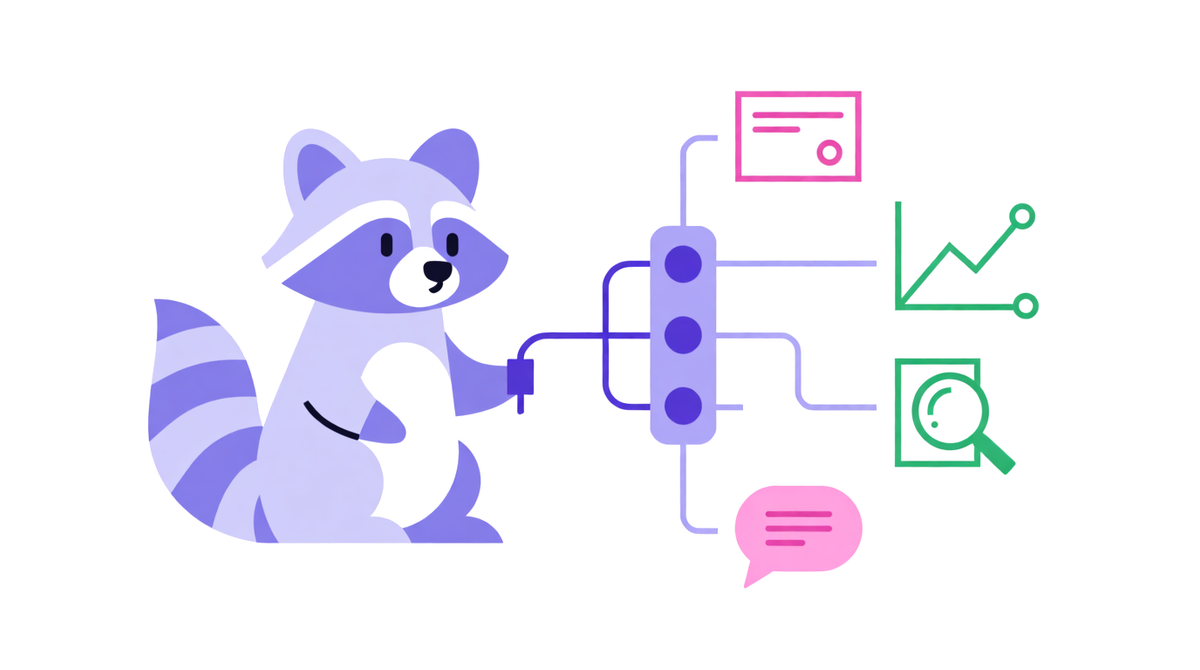
The best MCP servers for marketing in 2026 are the ones that own a data flow your team touches daily: Google Ads and Meta Ads AI Connectors for paid media, Ahrefs and Google Search Console for organic search, GA4 and SegmentStream for measurement, HubSpot, Mailchimp and Lemlist for lifecycle, and Slack, Notion and Figma for content and comms.
That list is deliberately short. Most marketing MCP roundups rank servers by vendor visibility. The ranking that survives contact with a real workflow comes down to two things: which data flow the server owns, and whether it wants write access to your live ad accounts.
How we picked these marketing MCP servers
Two inputs shape this guide. The first is measured demand: Improvado ranked 15 marketing and analytics MCP servers by trailing-28-day Google Search Console impressions on each server's documentation page, using first-party data queried on 2026-07-20. The same catalog lists 187 dedicated MCP integrations as of July 2026, so the shortlist is drawn from a much larger field.
That demand ordering puts Grafana (529 impressions), Lemlist (503), Google Search Console (441), LinkedIn Ads (324) and Google Trends (293) at the top, ahead of Facebook Ads (106) and Mailchimp (101). Impressions on a documentation page are an imperfect proxy for value, but they are an honest one: they measure how many people were about to wire that integration up.
The second input is the access model. We checked what each server can change, not only what it can read.
Who maintains it: an official server shipped by the platform, or a community server with a named maintainer and an active issue tracker. An unclaimed repository is a liability you adopt for free.
What it can change: read-only reporting, versus read-write campaign edits, and whether those edits land paused or live.
How it authenticates: OAuth 2.0 with per-user consent, or a long-lived API token pasted into a config file nobody rotates.
Where it runs: remote HTTPS servers need no local install, local stdio servers need Node or Python on every machine that uses them.
What it costs: free with the subscription you already pay for, per seat, or per API call.
Paid media MCP servers: ads, bidding and creative
Paid media is the most crowded corner of the market and the one with the most write-access risk. Google's official server is read-only and queries campaigns through GAQL; our Google Ads MCP server walkthrough covers which tools ship today and which are still missing. Meta's official Ads AI Connectors server is read-write across 29 tools, with new campaigns created in a paused state, a sensible default that most community servers do not bother with, as BlueAlpha's 13-server comparison documents.
Multi-platform servers exist, and each one is a vendor selling coverage rather than a neutral directory. Synter advertises 14 ad platforms from $199/month. Adspirer covers six with a free tier capped at 15 API calls a month, then paid plans from $49/month. For B2B teams, LinkedIn Ads is the platform where an MCP server earns its keep fastest, because the account data is small enough that a well-scoped read-only connection answers most reporting questions.
The trap in this category is buying a campaign-management server for a research job. If what you need is competitor ad data, a server that asks for credentials to your own ad account is the wrong shape entirely, and our breakdown of campaign management versus ad intelligence servers is the ten-minute version of that argument.
SEO and measurement MCP servers: organic search, analytics and attribution
On the organic side, Ahrefs exposes 112 tools through its hosted server, free with an active subscription, covering keyword research, backlink data and site audits. Google Search Console is the sharper input for demand work because it is first-party: your own query and impression data rather than a modelled estimate. Tally's writeup on their own stack is a useful reality check on how often these servers get used versus merely connected.
Measurement is where the money questions live. GA4 MCP servers expose more than 200 dimensions and metrics. Grafana connects panels, alert thresholds and time series, which is what lets an agent answer "which metric breached overnight" without a human opening a dashboard. SegmentStream sells multi-touch attribution and BigQuery modelling rather than raw access, quoted at enterprise pricing, and Flint's B2B review puts the same distinction at the centre: measurement depth matters more than connector count.
Attribution work is the strongest argument for connecting several servers at once. "Which channel drove pipeline last quarter" needs ad spend, CRM outcomes and a conversion baseline in the same context. No single marketing MCP server can answer it alone, which is why the read-only servers are worth wiring before the write-capable ones.
CRM, lifecycle and content MCP servers
HubSpot is the cheapest useful connection most B2B teams can make. The server is free with the free CRM tier, it carries no per-call cap, and putting pipeline data next to ad data turns spend reports into revenue reports.
Lemlist covers cold email sequences, leads and engagement events such as opens, clicks and replies, and it ranks second by measured demand for exactly that reason. Mailchimp handles email marketing and audience data. Contentful covers headless CMS content operations, which matters when the campaign brief and the published page have to stay in step.
Content and comms servers round out the stack: Notion for briefs and internal docs, Figma for design files and creative assets, Slack for the informal decisions that never make it into either. Slack's server reached general availability in February 2026 and is free on free and paid workspaces.
What separates a good marketing MCP server from a bad one?
Four tests. If a server fails two of them, do not connect it to a production workspace.
It answers a question your team already asks every week, in one call, without a CSV export in the middle.
Its tool descriptions are written for a model: named parameters, defined units, explicit date handling, and no tool that silently truncates results at 100 rows.
Its write operations are reversible and land paused or in draft state by default.
It has a public changelog and a maintainer who answers issues, because the tool list will change faster than your prompts.
Do you need write access to your ad accounts?
For most marketing teams, no. The 2026-07-28 MCP specification aligned authentication with OAuth 2.0 and OIDC, which makes scoped and revocable access practical, but designing the scope is still your job rather than the protocol's. This adoption analysis tracks how quickly the ecosystem normalized that pattern.
A working default: connect read-only first, upgrade exactly one server to write access when a recurring task genuinely cannot be done without it, and revoke the token when the research task ends. An agent with write access to a live account runs every prompt against that account by default, whether or not the prompt was about it.
Which marketing MCP servers should you connect first?
Sequence beats completeness. A four-week order that produces a usable answer at every stage:
Week 1: Google Search Console plus your main ad platform's read-only server. This is the pair that answers what is happening right now.
Week 2: GA4 or your warehouse server, so campaign numbers have a conversion baseline.
Week 3: Meta Ads AI Connectors in read-only mode, then paused-write only if a recurring task genuinely needs it.
Week 4: HubSpot or your CRM, which is the connection that turns ad reporting into revenue reporting.
After that: Ahrefs, Lemlist, Notion, Figma and Slack, in whatever order your team's questions arrive.
The hidden cost of an MCP stack spread across seven vendors
Every server adds an authentication surface, a token to rotate, a tool list that competes for the model's attention, and a failure mode that looks like a bad answer rather than an outage. Ten connected servers with overlapping tools make an agent worse at picking the right one.
Saturation arrives faster than teams expect. Tally's team reported that roughly six in ten of their AI conversations now touch at least one MCP server, with a small handful doing most of the work. The servers in that handful are the ones worth hardening. The rest are experiments.
The ecosystem's growth rate is the other warning. Anthropic's December 9, 2025 ecosystem update counted more than 10,000 active public servers and 97 million monthly SDK downloads. By July 2026, Anthropic reported SDK downloads above 400 million a month. A stack that was state of the art in January is a maintenance liability by September.
Registry counts tell the same story with less precision. The official MCP registry held 9,652 latest server records in a May 24, 2026 snapshot, and GitHub's mcp-server topic covered 15,926 repositories on the same date, according to this statistics roundup. That is roughly three times the number any marketing team could evaluate in a quarter.
Where adextract fits in a marketing MCP stack
adextract's MCP server covers the ad-intelligence side of the stack: reading public ad library data across Meta, Google, TikTok, LinkedIn and other platforms, without asking for credentials to your own ad accounts. How MCP servers connect AI agents to ad platforms covers the full wiring, including the read-only versus read-write split that decides what an agent is allowed to touch.
Be clear about what it is not. It does not replace the campaign-management servers above, and it does not report on your own account's performance. It answers the question those servers cannot: what your competitors are running right now, in a form an agent can reason about.
Marketing MCP servers: what changes in the next twelve months
Three things are likely, based on what happened in 2026 so far. First, per-platform official servers keep absorbing the community ones, which is good for reliability and bad for anyone whose whole differentiation was being the unofficial bridge. Second, OAuth scoping becomes a procurement question rather than a developer one, as security review catches up with the installed base.
Third, the buying decision moves up. The question is shifting from whether to connect an MCP server at all to which two or three the team standardizes on, because a stack nobody agreed on is a stack nobody maintains.
If you connect one thing this month, make it a read-only server that answers a question you already ask every week. Add the second one only after the first is part of how the team works. Cataloguing every server published in 2026 is not the goal. A short stack your team trusts is.
Frequently asked questions
What are the best MCP servers for marketing in 2026?
For paid media, Google Ads and Meta Ads AI Connectors. For organic search, Ahrefs and Google Search Console. For measurement, GA4, Grafana and SegmentStream. For CRM and lifecycle email, HubSpot, Mailchimp and Lemlist. For content and comms, Notion, Figma, Slack and Contentful. The best starting pair for most teams is Google Search Console plus a read-only ad platform server, because together they answer what is happening without granting write access to anything.
Do marketing MCP servers need write access to my ad accounts?
Most do not. Read-only servers cover reporting, campaign queries and ad library research. Write access is only required when an agent has to change campaigns, budgets or creatives, and even then a good server creates those changes in a paused or draft state so a human reviews them before spend moves.
Are marketing MCP servers free?
Several are. Google's official Google Ads server is free and open source, Grafana, GA4 and Slack servers are free, and HubSpot's is free with the free CRM tier. Ahrefs and Intercom require a paid subscription to the underlying product. Multi-platform vendors such as Synter start at $199 per month, and Adspirer at $49 per month after a free tier of 15 API calls.
Can you use marketing MCP servers with ChatGPT, not just Claude?
Yes. MCP is a vendor-neutral open standard, now stewarded by the Linux Foundation, and it is supported across Claude, ChatGPT, Cursor, Gemini and Microsoft Copilot. The server does not care which client connects to it. What changes is where you install it and how each client handles remote versus local servers.