
July 26, 2026 · 9 min read
How to scale ad creative production: a framework for lean performance teams
A practical framework for scaling ad creative production without an agency. Build internal workflows, pick the right tools, and ship 4x more creative variations per week.
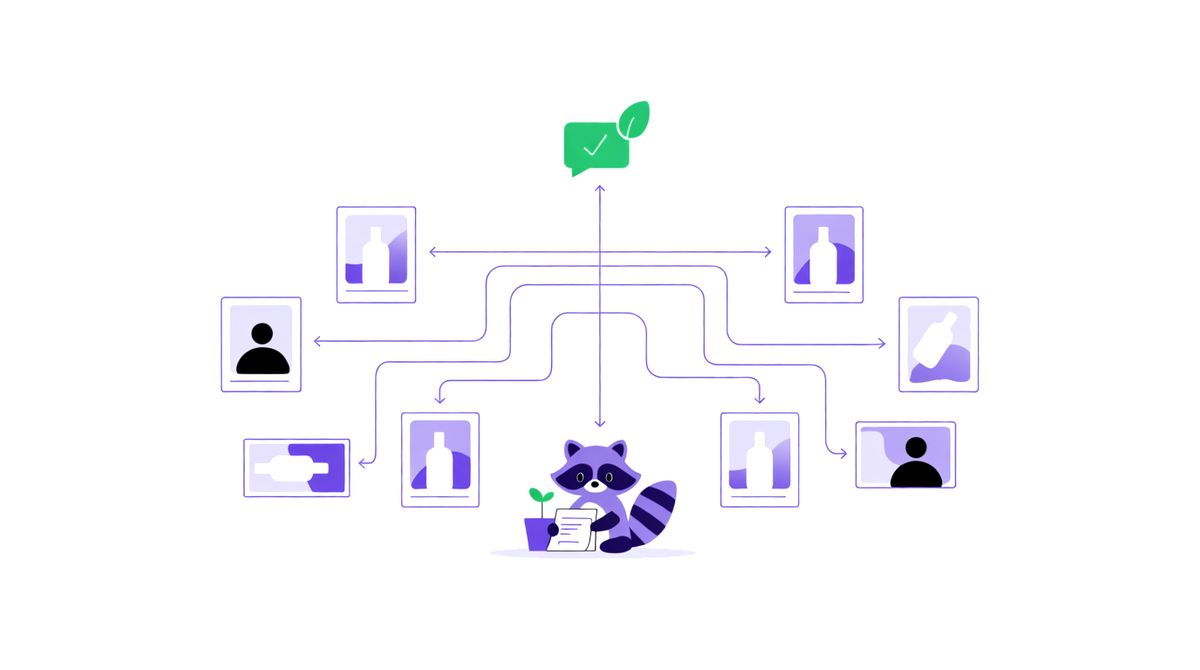
Most performance teams hit the same wall around month six. Campaigns are scaling, spend is growing, and suddenly the creative pipeline can't keep up. The three ads that worked at $5k/month don't work at $50k/month. Frequency climbs, CTR drops, and your account manager is asking for fresh assets you don't have.
This is the creative production bottleneck, and it kills more ad accounts than bad targeting ever did. The fix isn't hiring a bigger agency or doubling your creative retainer. It's building an internal production system that can ship variations faster than your audience fatigues on them.
Here's the framework. No theory. Just what works for lean teams shipping paid social and search at scale.
Why creative production bottlenecks kill your ad performance
Meta's algorithm doesn't just target audiences anymore. It uses your creative as a targeting signal. Each ad teaches the system who responds to your product. When you run the same three ads for weeks, you're not just boring your audience. You're starving the algorithm of the data it needs to find new pockets of profitable users.
The numbers make this concrete. Advertisers with limited creative variety pay what one analytics firm calls a "monotony tax": higher CPMs, lower reach, and steadily climbing CPAs. The account doesn't fail suddenly. It degrades week by week, and by the time you notice, you've already burned budget on fatigued audiences.
The performance teams that avoid this cycle share one trait: they treat creative production as operational infrastructure, not a marketing expense. They build pipelines that ship new variations weekly. They measure creative velocity the same way they measure ROAS. And they structure their teams around production throughput, not campaign management.
The agency model is structurally slow (and what to do about it)
Agencies aren't bad. They're optimized for the wrong thing. The standard agency model brief to creative director to designer to revision cycle takes five to seven business days per batch. By the time the new creative ships, the performance data that prompted the brief is two weeks old. You're optimizing against stale signals.
One B2B SaaS team documented their experiment replacing a $6,000/month agency retainer with an internal AI-assisted workflow. The agency delivered one polished creative batch per week with a five-day turnaround. Their internal workflow shipped four variations per week with same-day turnaround. The quality gap was real in week one and mostly closed by week six. What didn't close was the iteration speed gap: the internal team could test four angles in the time the agency delivered one.
This doesn't mean agencies are useless. It means the default model, briefing an external team through an account manager who briefs a creative director who briefs a designer, is too slow for performance marketing at scale. The fix isn't firing your agency. It's building an internal layer that handles iteration and velocity, then using agencies for net-new concept work and high-production-value hero assets.
Build your creative production system: the four components
A production system that ships consistently needs four components. Skip any one of them and you'll hit a different bottleneck within weeks.
Component one: the creative brief template. This is the most important asset in your pipeline. A tight brief specifies the hook (first three seconds), the core message (what changes after using your product), the proof point (data, testimonial, or demo), and the format (static, video, carousel). The brief is not a mood board. It's a production spec. The person writing it needs to be close to performance data so they brief against what's actually working, not what looked good in last quarter's brand deck.
Component two: the asset library. You need a searchable, organized repository of raw materials: product screenshots, customer testimonial clips, b-roll footage, brand assets, and previously tested creative elements. If every new brief starts from scratch, you'll never hit velocity. The asset library lets you remix and iterate instead of reinventing. Store it somewhere both the performance team and creative team can access without asking for permissions.
Component three: the production stack. Pick tools that reduce time-to-ship, not tools with the most features. For static ads, Canva or Figma with templates. For video, AI-assisted tools like Atlabs, Captions, or Runway for quick cuts. For copy variations, Claude or ChatGPT with a saved prompt template that mirrors your brief format. The stack should cost under $500/month for a lean team. If you're spending more than that on tools before you've proven the pipeline works, you're optimizing the wrong variable.
Component four: the launch calendar. Ship on a fixed cadence. Not "when we have something ready." Pick a day. Tuesday and Thursday are common. Every Tuesday, four new creative variations go live. Every Thursday, two more. Fixed cadence does two things: it forces you to maintain production momentum, and it gives the algorithm a predictable stream of new signals. Most teams that fail at creative scaling fail because they launch eight ads one week, then nothing for three weeks. The algorithm hates inconsistency.
How to structure your team for creative velocity
The org chart matters more than the tools. Most teams organize by function: the UA manager runs campaigns, the creative team makes assets, and they meet once a week to compare notes. This structure guarantees latency. By the time the creative team hears about a winning angle, the UA manager is already optimizing against newer data.
The fix: embed creative production inside the performance team. One person, call them a creative strategist or a growth creative, sits in the same Slack channels, sees the same dashboards, and writes briefs based on live performance data. They don't need to be a designer. They need to write tight briefs and operate the production tools. Their KPI is creative velocity: variations shipped per week, not campaigns managed.
For teams under 10 people, this is a part-time role. One person spending 30% of their week on creative production can ship four to six variations weekly once the brief template and tool stack are established. The SaaS team that replaced their agency did exactly this: one team member at roughly 30% capacity, $300/month in tool costs, and a part-time creative strategist for oversight. Total monthly cost under $1,500 vs. $6,000 for slower output.
The hardest part of this transition isn't the tools. It's the brief quality. The tools are interchangeable. A bad brief produces bad output regardless of whether you're using AI or a human designer. Invest in brief-writing skills before you invest in more tools. If nobody on your team can write a tight creative brief with a specific hook, message, proof point, and format, fix that first.
The tools that actually reduce production time
The tool landscape is noisy. Every vendor claims to "10x your creative output." Ignore the claims. Look at what reduces time-to-ship for your specific formats.
For static ads: Figma with a template library. Build 10 to 15 templates with locked brand elements and swappable copy, images, and CTAs. One template can generate 20 variations in under an hour.
For video ads: Atlabs handles brief-to-first-cut in minutes. Runway and Captions are solid for polish and captions. The key is separating rough-cut production (fast, AI-assisted) from polish (slower, human). Ship rough cuts for testing. Polish the winners.
For copy: Claude or ChatGPT with a saved prompt that mirrors your brief template. Feed it the hook, message, and proof point. Ask for 10 headline variations, 5 body copy variations, and 5 CTA variations. Pick the best three and test them.
For competitive intelligence: This is where adextract fits into your pipeline. Before you brief new creative, check what's actually running in your category. AI agents that monitor competitor ads across Meta, Google, TikTok, and LinkedIn give you a live feed of what angles competitors are testing. Instead of guessing which hooks to try, you brief against what's already being validated in your market. If three competitors are running pain-point hooks with UGC style, you have a signal. If nobody is running comparison ads, you might have whitespace. See how AI agents monitor competitor ads for the full breakdown.
One rule: don't buy tools before you have a process. A clean brief template and a messy Google Drive will outperform a messy brief and the best creative management platform. Standardize the process, then automate it.
Measuring what matters: metrics for a scaled creative pipeline
Most teams measure creative success at the campaign level. ROAS, CPA, CTR. These tell you if your account is healthy. They don't tell you if your production pipeline is healthy. You need production-level metrics.
Track these five numbers weekly:
Creative velocity: How many distinct creative variations shipped this week. Target: four to six for a lean team running two channels.
Brief-to-live time: Hours from brief finalization to creative going live. Target: under 24 hours for standard formats. If it's taking three days, your stack or your process is broken.
Creative freshness ratio: Percentage of active spend running on creatives less than 30 days old. Target: above 60%. If most of your spend runs on two-month-old ads, you're in fatigue territory.
Win rate: Percentage of new variations that beat the current top performer on CPA within seven days. Target: above 20%. If your win rate is single digits, your briefs are weak or you're iterating on the wrong signals.
Creative fatigue rate: Number of active creatives with frequency above 4.0 and CTR decline over 20%. This is your replacement queue. If this number is growing faster than your velocity, your pipeline is losing the race.
Review these metrics in a weekly 15-minute standup with the person running production and the person managing campaigns. The goal isn't blame. It's spotting bottlenecks before they show up in your ROAS. If velocity dropped from six to two, ask what broke. If win rate is low, review the last five briefs together and identify the pattern.
When to bring in outside help (and when to stay internal)
Internal production isn't an all-or-nothing decision. The smartest teams use a hybrid model.
Keep in-house: Iteration on winning angles. When a hook works, the variations should ship same-day. This requires someone who sees the data in real time and can brief, produce, and launch without a handoff chain.
Consider outsourcing: Net-new concept development. When you're entering a new channel or testing a completely new angle, an external creative team brings fresh perspective. Hero assets for high-spend campaigns. If you're spending $50k/month on a single campaign, the production quality ceiling matters. An agency can deliver polish that internal AI-assisted workflows can't match yet.
The rule of thumb: if the insight that prompted the creative is less than 48 hours old, produce it internally. Speed is the advantage. If the asset has a two-week shelf life and needs production polish, an agency is still the right call.
The teams winning at scale aren't the ones with the biggest creative budgets. They're the ones with the shortest distance between performance data and new creative. That's not a tool problem. It's a system problem. Build the system, and the output follows.
If you want to skip the manual research on what competitors are testing, adextract's AI agents monitor ad libraries across platforms and surface the creative angles and hooks that are actually running in your category. Less guesswork, faster briefs.
Frequently asked questions
How many ad creatives should a lean performance team produce per week?
A lean team running two channels (Meta and Google, or Meta and LinkedIn) should target four to six distinct creative variations per week. This includes format variations (static, video, carousel) and messaging angle variations. The number matters less than consistency. Shipping four every week beats shipping ten one week and zero the next.
What's the difference between creative velocity and creative volume?
Creative velocity is the speed and accuracy with which you produce, test, and iterate on high-performing concepts. Creative volume is just the total number of ads. Velocity matters because the algorithm needs a constant supply of fresh signals. High volume without structure means random testing with diluted data. High velocity means quick iteration on proven winning elements.
Can a small team really replace an agency for creative production?
Yes, but not completely. One person spending 30% of their time on creative production, equipped with a tight brief template and a modest tool stack ($300/month), can ship four to six variations weekly. This covers iteration and velocity. Agencies still make sense for net-new concept development, hero assets for high-spend campaigns, and production quality that AI tools can't yet match. The hybrid model works best: internal for speed, external for polish.
What's the most important skill for an internal creative producer?
Brief writing. Not design. Not video editing. A tight creative brief with a specific hook, message, proof point, and format produces good output from any tool. A vague brief produces bad output regardless of how expensive the tool is. Invest in brief-writing skills before you invest in more software.
How do I know when a creative is fatigued and needs replacement?
Two thresholds: frequency above 4.0 and CTR decline over 20% from peak. Track both per creative. When both triggers fire, that creative goes into your replacement queue. Don't wait for CPA to spike. By then, you've already burned budget on a fatigued audience. If you want a deeper framework for detecting fatigue before it hits your ROAS, see our guide on creative fatigue detection.