June 17, 2026 · 11 min read
What is ad monitoring: how AI agents are changing competitive ad intelligence
The competitive ad intelligence market hit $2.28 billion in 2025 and is growing 16% annually. AI agents are reshaping how agencies monitor competitor ads across Meta, TikTok, Google, and LinkedIn.
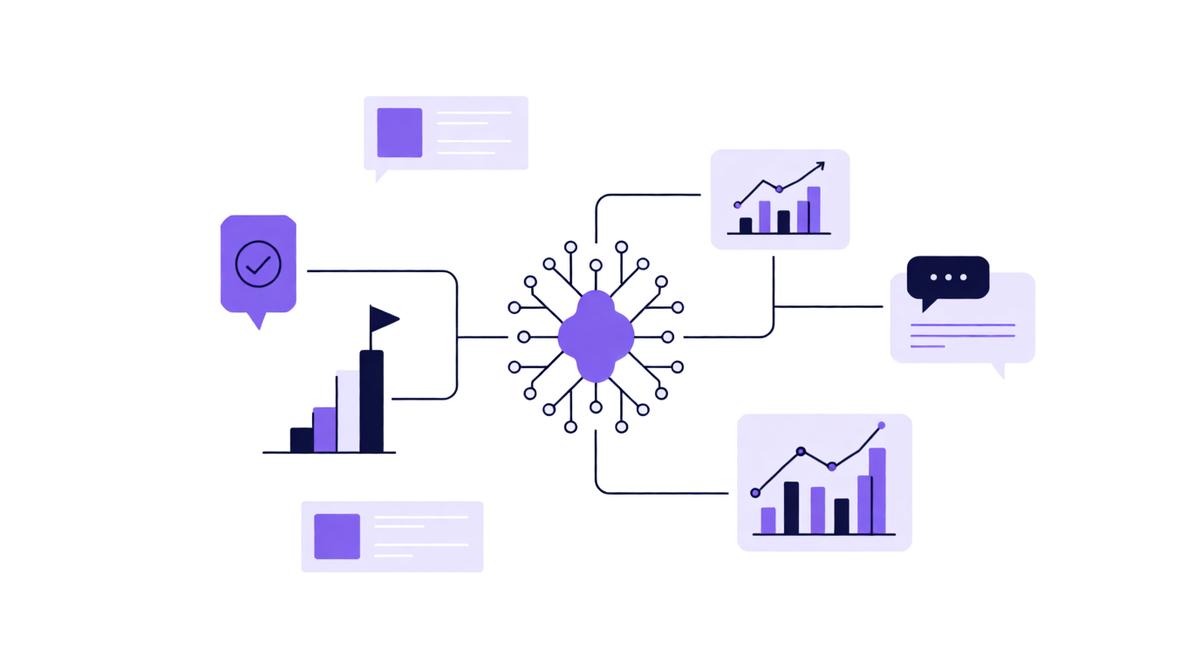
The AI-powered competitive ad tracking market reached $2.28 billion in 2025 and is projected to hit $2.65 billion in 2026 — a 16.2% compound annual growth rate. Agencies that monitor competitor ads manually are falling behind. The ones wiring ad intelligence directly into their AI agent workflows are pulling ahead.
Why manual ad monitoring broke
Five years ago, competitive ad intelligence meant one thing: opening Facebook Ad Library, typing a brand name, and scrolling. That workflow worked when a performance marketer managed three clients and ran fifteen campaigns a quarter.
It does not work anymore. A mid-size performance agency today runs 200 to 400 active campaigns across Meta, Google, TikTok, and LinkedIn simultaneously. Each competitor those campaigns face is running their own set of ads. Multiply that across ten clients and you are tracking thousands of ad creatives — every headline variant, every video hook, every landing page redirect.
Manual monitoring creates three problems that compound:
- Latency: By the time your team spots a competitor's new creative, it has been running for two weeks. You are optimizing against stale data.
- Coverage gaps: Facebook Ad Library shows Meta ads. Google Ads Transparency Center shows Google ads. TikTok Ad Library shows TikTok ads. No single interface shows all of them. Most teams check one platform, skip the rest.
- No agent integration: Ad libraries are built for humans clicking through UIs. They are not built for AI agents that need structured, queryable data to analyze creative trends, generate counter-briefs, or flag competitor pivots in real time.
What AI-powered ad monitoring actually does
Modern ad monitoring is not just about seeing what competitors are running. It is about feeding that intelligence into a system that acts on it. Here is the workflow that the best agencies are building:
1. Cross-platform creative collection
The first layer is data collection. An AI agent queries ad libraries across Meta, TikTok, Google, and LinkedIn simultaneously. It pulls every active ad from every competitor you track — not just the ads you remember to check. This produces a searchable, structured dataset instead of a pile of screenshots in a Slack channel.
2. Creative pattern detection
Once the data is collected, the agent analyzes it for patterns. Which hooks is this competitor using across campaigns? Are they running UGC-style videos or polished brand spots? Have they shifted from static images to carousel ads in the last 30 days? These are questions a human analyst can answer for one competitor over a coffee. An AI agent can answer them for 50 competitors in 90 seconds.
3. Automated briefing and counter-positioning
The third layer is where the ROI materializes. The agent generates a creative brief that includes competitor analysis: what angles competitors are using, which formats are trending in the category, and where there are gaps your client can own. Instead of a strategist spending three hours on competitor research before writing a brief, the agent delivers the research and the strategist spends 45 minutes refining the creative direction.
Why agencies are wiring ad intelligence directly into AI agents
The US marketing agencies market was valued at $182.49 billion in 2025. That is a lot of competition. The agencies winning new business are not the ones with the best creative directors — they are the ones who can prove they understand the competitive landscape better than anyone else.
Three specific agency workflows are driving adoption of AI-powered ad monitoring:
- New business pitches: Walk into a pitch with a competitive audit of the prospect's top three competitors — every ad they ran in the last 90 days, categorized by format, hook, and platform. That wins deals.
- Client reporting: Replace the monthly "here is what your competitors are doing" slide that took an analyst six hours to build. An agent generates it in 90 seconds, and the analyst spends their time on strategic recommendations instead of data entry.
- Campaign optimization: When a competitor drops a new video ad that starts gaining traction, your agent flags it. When they shift budget from Meta to TikTok, your agent detects the pattern. You do not wait for the quarterly competitive review to react — you adjust creative strategy in days.
The MCP server advantage: why agents need structured ad data
Most ad monitoring tools are built for humans. They give you a dashboard, a search bar, and an export button. That is fine if you are a solo media buyer checking competitors once a week. It is not fine if you are trying to wire competitive intelligence into an AI agent that makes decisions autonomously.
This is where the Model Context Protocol (MCP) changes the game. An MCP server exposes ad intelligence as structured, queryable data that any AI agent can consume directly. Instead of copy-pasting ad screenshots into ChatGPT and asking it to analyze them, your agent queries the MCP server: "Show me every video ad run by Competitor X on Meta in the last 30 days, ranked by estimated spend." The agent gets structured results, analyzes them, and produces a creative brief — all without a human in the loop.
adextract built its competitive ad intelligence platform as an MCP server first. The reasoning is simple: agencies and performance marketers are moving toward agent-native workflows. The tools that provide structured, queryable data to those agents will replace the tools that require a human to log in and click around.
How to build an AI-powered ad monitoring workflow
If you are an agency or performance marketer who wants to move from manual ad library checks to an AI-powered workflow, here is the stack to build:
- Define your competitive set: Pick 10 to 30 competitors that matter. Do not track everyone. Track the ones whose ad strategy actually affects your clients' performance.
- Set up cross-platform monitoring: Use a tool that covers Meta, TikTok, Google, and LinkedIn. If you are only checking one platform, you are missing 70% of the competitive picture. adextract covers all four through a single MCP endpoint.
- Wire the data to your AI agent: Connect the MCP server to your agent of choice — Claude, ChatGPT, Hermes, or a custom agent you built. The agent can now query competitive data on demand instead of waiting for a human to provide it.
- Automate the reports: Set up weekly competitive briefs that your agent generates automatically. Include: new creatives launched, creative format shifts, hook analysis, and platform allocation changes. Deliver these to your strategy team before Monday standup.
- Build a feedback loop: The first set of agent-generated briefs will not be perfect. Have your strategists flag what is useful and what is noise. Over 4 to 6 weeks, the agent learns what matters for your specific clients and categories.
What changes when ad monitoring goes agent-native
The shift from manual ad monitoring to agent-native competitive intelligence changes three things about how agencies operate:
- Speed to insight drops from weeks to hours. A competitive audit that took a junior strategist 15 hours now takes 12 minutes. The strategist's time shifts from data collection to strategic thinking.
- Coverage goes from partial to comprehensive. Instead of checking three competitors on Meta once a week, you monitor 25 competitors across four platforms continuously. You catch competitive moves the day they happen, not the day you happen to check.
- The competitive intelligence function scales. A five-person performance agency and a 200-person holding company can run the same ad monitoring infrastructure. The cost does not scale linearly with client count — the AI agent does the heavy lifting.
The agencies winning in 2026 are not the ones with the biggest research teams. They are the ones who built the best feedback loop between competitive data and creative strategy. AI agents close that loop.
Getting started with competitive ad intelligence
You do not need to rebuild your entire stack overnight. Start with one client, one competitive set, and one weekly brief. Pick the competitor that your client asks about most often. Set up monitoring across Meta and TikTok — those two platforms cover 80% of the competitive picture for most D2C and B2B brands. Run the workflow for four weeks and measure the time saved against the manual process.
Competitive ad intelligence is not a nice-to-have in 2026. It is the difference between reacting to competitor moves three weeks late and anticipating them before they hit your clients' performance. AI agents make that possible at scale — and the agencies that build this capability first will have a structural advantage that is very hard for competitors to copy.
Frequently asked questions
What is competitive ad intelligence?
Competitive ad intelligence is the practice of systematically monitoring, collecting, and analyzing competitor advertisements across platforms like Meta, TikTok, Google, and LinkedIn. It goes beyond seeing what ads are running — it identifies creative patterns, format shifts, platform allocation changes, and messaging pivots that signal competitive strategy changes.
How does AI-powered ad monitoring differ from manual ad library checks?
Manual ad library checks require a human to visit each platform individually, search for competitor brands, and manually log findings. AI-powered monitoring queries all platforms simultaneously through structured APIs, collects ad creatives into a searchable dataset, and uses large language models to analyze creative patterns at scale. A process that took 4 to 6 hours manually takes 60 to 90 seconds with AI.
What is an MCP server and why does it matter for ad intelligence?
The Model Context Protocol (MCP) is an open standard that lets AI agents interact with external tools and data sources through a structured interface. An MCP server for ad intelligence exposes competitor ad data as queryable endpoints — your AI agent can ask for "every video ad from Competitor X in the last 30 days" and get structured results it can analyze. This replaces the copy-paste workflow of downloading CSV exports and pasting them into ChatGPT.
Is competitor ad monitoring compliant with platform policies?
Yes. Competitive ad monitoring tools like adextract only access publicly available ad data from official ad libraries and transparency centers — Meta Ad Library, TikTok Ad Library, Google Ads Transparency Center, and LinkedIn Ad Library. These are publicly accessible by design and do not require authentication, scraping, or bypassing any platform restrictions.
How many competitors should an agency monitor?
Start with 10 to 15 direct competitors per client and expand to 25 to 30 over time. Include both direct competitors (companies selling similar products to the same audience) and adjacent competitors (companies in related categories whose ad strategies influence your market). The AI handles the scale — the constraint should be strategic relevance, not collection bandwidth.